The difference lies in the next step
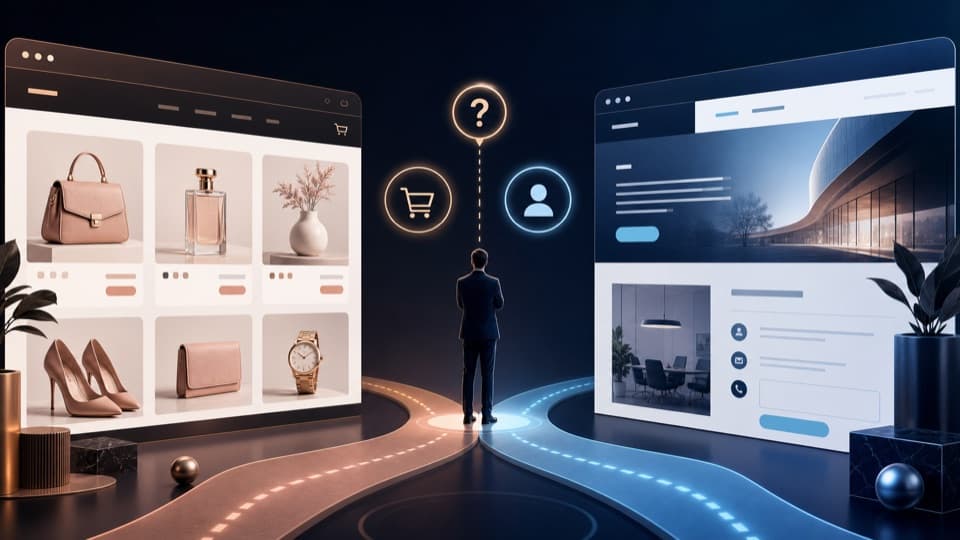
A website informs and leads to an enquiry. An online shop leads to a purchase. In between, there are many hybrid forms: booking pages, product catalogues, enquiry configurators or landing pages.
The right solution depends on how customers decide. Do they buy immediately? Do they compare first? Do they need advice or an appointment?
When an online shop makes sense
A shop makes sense when products can be clearly described, priced and shipped directly or provided digitally. Then good categories, product pages, a basket and a clean checkout count.
For fashion, beauty products, digital templates or clearly defined offers, a shop can be a strong sales channel.
- Products are unambiguous and can be bought directly
- Prices and variants are clear
- Customers need little personal advice
- Shipping, payment and order processing are in place
Which solution customers really expect
The decision should be made from the customers' point of view. Someone who wants to buy a product expects variants, price, images, delivery information and a simple order process. Someone looking for a service expects trust, explanation, examples and an uncomplicated enquiry path.
That is why a shop is not automatically more professional than a website. The professional solution is the one that fits the decision situation and enables the next step without detours.
- For products, quick orientation in the range counts
- For services, trust before the enquiry counts
- For individual offers, an enquiry form helps more than a basket
- For recurring bookings, an appointment module can make sense
Why fewer features are often better
Many digital presences are planned in an overly complicated way. A shop does not need every feature right away if only a few products are sold at the start. A service page does not need a basket if every offer is discussed individually.
A lean start with the features customers actually use is better. After that, the solution can be extended when real requirements arise, rather than just collecting theoretical possibilities.
- Only build in features that make the next step easier
- Clearly separate checkout, enquiry or booking from one another
- Only add complexity when it is needed
- Do not make technology more important than clarity
When a website is the better fit
If the offer is individual, the website should first build trust and clarity. Then an enquiry, an initial consultation or an appointment booking is often more sensible than a basket.
Digital Vision plans such decisions early so that the website does not become unnecessarily complicated.